

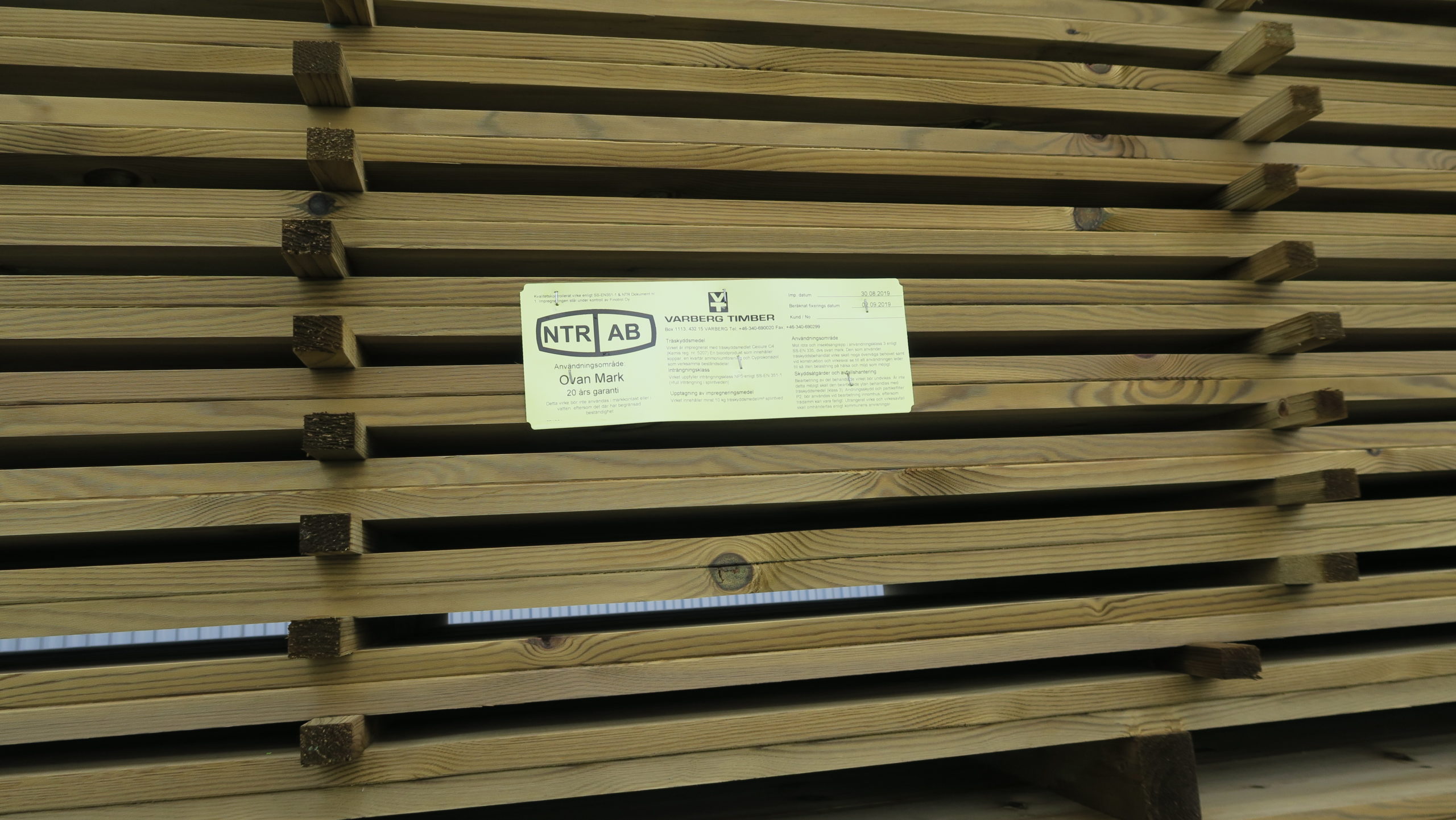
Komplett tabell över alla NTR träskyddsklasser och tillhörande användningsklass och produktdata.

| Wood protection class | NWPC Quality Mark | Use Class according to EN 335 | NWPC protection class general usage | Colour code | Short Description | Wood Species | Scope | Use Clas Desription | Service conditions | Manufacturing technology | Penetration class according to EN 351-1 | Penetration | Penetration class description | Retention requirements | |||
|---|---|---|---|---|---|---|---|---|---|---|---|---|---|---|---|---|---|
| NTR A |  | UC 4 | Consumer, Construction, Utility poles, Sleepers, Industrial joinery | WHITE | Preservative treated Pine or other soft wood for in ground contact use | Pine (Pinus spp) and other permeable softwoods according to EN 350 with sapwood that is classified as treatability class 1. | The wood protection classes refer only to the protection against biological deterioration. Any other requirements on the treated wood, such as wood quality grading, machining before treatment and moisture content on delivery must be specified separately. | Yes | Wood in contact with the ground or fresh water or severely exposed to the weather; or if a wood component is inaccessible or where the consequences of failure will be particularly serious. | Exterior stairs, load-bearing wooden structures, balcony and stair railings. Wire posts, piles, sleepers, fence posts, bridges | Vacuum pressure impregnation | NP5 | 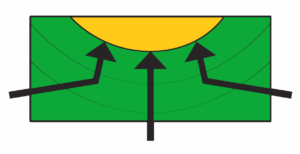 | Full sapwood | According to NWPC approval for the wood preservative | ||
| NTR A GL |  | UC 4 | WHITE | Wood protection class NTR AGL against rot and insects in Use Class 4 according to EN 335. | Pine (Pinus spp) and other permeable softwoods according to EN 350 with sapwood that is classified as treatability class 1. | The wood protection classes refer only to the protection against biological deterioration. Any other requirements on the treated wood, such as wood quality grading, machining before treatment and moisture content on delivery must be specified separately. | Yes | Glulam wood products of pine with very good resistance in contact with soil or exposed to high moisture load or structures above ground where personal safety or long service life requires structural integrity, or which may be difficult to inspect or replace and to ensure a long service life. | Wood in contact with the ground or fresh water or severely exposed to the weather; or if a wood component is inaccessible or where the consequences of failure will be particularly serious. | Treating assembled components (duolam and tri-lam) | Vacuum pressure impregnation | NP5 | Full sapwood | According to NWPC approval for the wood preservative | |||
| NTR A mod |  | UC 4 | Consumer, Construction, Industrial joinery, Utility poles, Sleepers | WHITE | Chemical modified wood for in ground contact use | Wood species in accordance with NTR approval | The wood protection classes refer only to the protection against biological deterioration. Any other requirements on the treated wood, such as wood quality grading, machining before treatment and moisture content on delivery must be specified separately. | No | Wood in contact with the ground or fresh water or severely exposed to the weather; or if a wood component is inaccessible or where the consequences of failure will be particularly serious. | Exterior stairs, load-bearing wooden structures, balcony and stair railings. Wire posts, utility poles, piles, sleepers, fence posts, bridges | Chemical modification | NP5 | Full sapwood | According to NWPC approval for the wood preservative | |||
| NTR A Pole |  | UC 4 | Utility poles | WHITE | Preservative treated Pine or other soft wood for poles in ground contact use | Pine (Pinus spp) and other permeable softwoods according to EN 350. Permeable softwoods are those whose sapwood is classified in treatability class 1. | The wood protection classes refer only to the protection against biological deterioration. Any other requirements on the treated wood, such as wood quality grading, machining before treatment and moisture content on delivery must be specified separately. | Yes | Wood in contact with the ground or fresh water or severely exposed to the weather; or if a wood component is inaccessible or where the consequences of failure will be particularly serious. | Wire posts, utility poles, bridges | Vacuum pressure impregnation | NP5 |  | Full sapwood | According to NWPC approval for the wood preservative | ||
| NTR AB |  | UC 3 | Construction, Consumer, Industrial joinery | YELLOW | Preservative treated Pine or other soft wood for above ground use | Pine (Pinus spp) and other permeable softwoods according to EN 350 with sapwood that is classified as treatability class 1. | The wood protection classes refer only to the protection against biological deterioration. Any other requirements on the treated wood, such as wood quality grading, machining before treatment and moisture content on delivery must be specified separately. | Yes | Wood above ground and either continually exposed to the weather or subject to frequent wetting; where it is relatively easy to replace damaged components and where the consequences of failure will be moderate. | Vacuum pressure impregnation | NP5 | 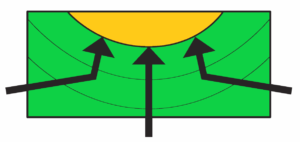 | Full sapwood | According to NWPC approval for the wood preservative | |||
| NTR AB Mod |  | UC 3 | Consumer, Construction, Industrial joinery | YELLOW | Chemical modified wood for above ground contact use | Wood species in accordance with NTR approval | The wood protection classes refer only to the protection against biological deterioration. Any other requirements on the treated wood, such as wood quality grading, machining before treatment and moisture content on delivery must be specified separately. | No | Wood above ground and either continually exposed to the weather or subject to frequent wetting; where it is relatively easy to replace damaged components and where the consequences of failure will be moderate. | Chemical modification | NP5 | Full sapwood | According to NWPC approval for the wood preservative | ||||
| NTR B |  | UC 3 | Industrial joinery | RED | Preservative treated Pine or other soft wood for use in window and door joinery, etc. | Pine (Pinus spp) and other permeable softwoods according to EN 350 with sapwood that is classified as treatability class 1. | The wood protection classes refer only to the protection against biological deterioration. Any other requirements on the treated wood, such as wood quality grading, machining before treatment and moisture content on delivery must be specified separately. | Yes | Wood above ground and either continually exposed to the weather or subject to frequent wetting; where it is relatively easy to replace damaged components and where the consequences of failure will be moderate. | Vacuum pressure impregnation | NP3 |  | Min 6 mm lateral into sapwood | According to NWPC approval for the wood preservative | |||
| NTR B Mod |  | UC 3 | Industrial joinery | RED | Chemical modified wood for use in window and door joinery, etc. | Wood species in accordance with NTR approval | The wood protection classes refer only to the protection against biological deterioration. Any other requirements on the treated wood, such as wood quality grading, machining before treatment and moisture content on delivery must be specified separately. | No | Wood above ground and either continually exposed to the weather or subject to frequent wetting; where it is relatively easy to replace damaged components and where the consequences of failure will be moderate. | Chemical modification | NP3 | Min 6 mm lateral into sapwood | According to NWPC approval for the wood preservative | ||||
| NTR GRAN |  | UC 3 | Consumer, Construction, Industrial joinery | ORANGE | Preservative treated spruce for use in some carpentry outdoors | Spruce | The wood protection classes refer only to the protection against biological deterioration. Any other requirements on the treated wood, such as wood quality grading, machining before treatment and moisture content on delivery must be specified separately. | Yes | Wood above ground and either continually exposed to the weather or subject to frequent wetting; where it is relatively easy to replace damaged components and where the consequences of failure will be moderate. | Vacuum pressure impregnation | NP1 | | None | According to NWPC approval for the wood preservative | |||
| NTR GW |  | UC 3 | Industrial joinery | BROWN | Preservative treated spruce for use in windows | Spruce | The wood protection classes refer only to the protection against biological deterioration. Any other requirements on the treated wood, such as wood quality grading, machining before treatment and moisture content on delivery must be specified separately. | Yes | Wood above ground and either continually exposed to the weather or subject to frequent wetting; where it is relatively easy to replace damaged components and where the consequences of failure will be moderate. | Vacuum pressure impregnation | NP1 | | None | According to NWPC approval for the wood preservative | |||
| NTR HC |  | UC 3 | Consumer, Construction, Industrial joinery | ORANGE | Preservative treated hart wood for use in cladding (Hartwood Cladding) | EN350-1 Durabillity class 3 or better | The wood protection classes refer only to the protection against biological deterioration. Any other requirements on the treated wood, such as wood quality grading, machining before treatment and moisture content on delivery must be specified separately. | No | Wood above ground and either continually exposed to the weather or subject to frequent wetting; where it is relatively easy to replace damaged components and where the consequences of failure will be moderate. | Vacuum pressure impregnation | NP1 | | None | According to NWPC approval for the wood preservative | |||
| NTR HW |  | UC 3 | Industrial joinery | BROWN | Preservative treated hart wood for use in windows (Hartwood Windows) | EN350-1 Durabillity class 3 or better | The wood protection classes refer only to the protection against biological deterioration. Any other requirements on the treated wood, such as wood quality grading, machining before treatment and moisture content on delivery must be specified separately. | No | Wood above ground and either continually exposed to the weather or subject to frequent wetting; where it is relatively easy to replace damaged components and where the consequences of failure will be moderate. | Vacuum pressure impregnation | NP1 | | None | According to NWPC approval for the wood preservative | |||
| NTR M |  | UC 5 | Consumer, Construction, Utility poles | BLUE | Preservative treated Pine or other soft wood for salt water contact | Pine (Pinus spp) and other permeable softwoods according to EN 350 with sapwood that is classified as treatability class 1. | The wood protection classes refer only to the protection against biological deterioration. Any other requirements on the treated wood, such as wood quality grading, machining before treatment and moisture content on delivery must be specified separately. | No | Wood constructions in sea water with salinity > 0,6% and constructions subject to extreme conditions or where there are special durability and strength requirements. | Vacuum pressure impregnation | NP5 |  | None | According to NWPC approval for the wood preservative | |||
| NTR M Mod |  | UC 5 | Consumer, Construction, Utility poles | BLUE | Chemical modified wood for salt water contact | Wood species is defined in accordance with NTR approval | The wood protection classes refer only to the protection against biological deterioration. Any other requirements on the treated wood, such as wood quality grading, machining before treatment and moisture content on delivery must be specified separately. | No | Wood constructions in sea water with salinity > 0,6% and constructions subject to extreme conditions or where there are special durability and strength requirements. | Chemical modification | NP5 | None | According to NWPC approval for the wood preservative |


